Twelve Indigenous artists explore the notion of “home.” Each undertakes a different and unique perspective reflective of his or her widely varied home communities and envisioned printmaking processes.
“Home: Contemporary Indigenous Artists Responding”
Norman Akers*
Neal Ambrose-Smith
Maile Andrade*
Corwin Clairmont
Joe Feddersen
Alexander Swiftwater McCarty
Tony Ortega*
Sue Pearson*
Jaune Quick-to-See-Smith
C. Maxx Stevens
Glory Tacheenie-Campoy*
Melanie Yazzie*
Kevin Slivka, Project Writer*
Curated by: Melanie Yazzie, Professor of Art and Head of Printmaking, University of Colorado at Boulder.
Project writer: Kevin Slivka, Ph.D., Assistant Professor of Art Education, State University of New York [SUNY], New Paltz.
Exhibitions
HOVAB @ BMoCA Present Box: Melanie Yazzie – Home: Contemporary Artists Responding
Boulder Museum of Contemporary Art
Boulder, CO
November 8 – November 20, 2016
—————————————————
Sojourner Truth Library, Exhibition Cases – K. Slivka [Curator/Organizer]
SUNY New Paltz
New Paltz, NY
December 11 – January 22, 2017
—————————————————
Sinclair Works on Paper Gallery – Neil Ambrose Smith & Juane Quick-to-See Smith [Curators/Organizers]
Sinclair Community College
Dayton, OH
February 1 – February 24, 2017
—————————————————
The Pennsylvania State University Libraries – K. Slivka [Organizer]
University Park, PA
January 18 – August 11, 2018
—————————————————
Artists:*
Norman Akers: was born and raised in Fairfax, Oklahoma. He is member of the Osage Nation from Grayhorse District. Currently, he is an Associate Professor of Drawing and Painting at the University of Kansas. Previous teaching experiences include the Institute of American Indian Arts, Santa Fe, New Mexico and the University of Illinois, Urbana-Champaign.
Akers had solo exhibitions at the Lawrence Arts Center, Lawrence, Kansas, Jan Cicero Gallery in Chicago, Illinois, at the Carl Gorman Museum, University of California, Davis, and the Gardner Art Gallery, Oklahoma State University, Stillwater, Oklahoma. He has participated in numerous group exhibitions including, Indelible Images: The Politics of the Social in Contemporary Art, Fort Wayne; Museum of Art, Fort Wayne, Indiana; Mapping: Memory and Motion in Contemporary Art, Katonah Museum of Art, Katonah, New York, Unlimited Boundaries; Who Stole the Tee Pee? at the National Museum of the American Indian, Smithsonian Museum, New York, New York. Akers’ paintings are included in numerous collections including the Gilcrease Museum, Tulsa, Oklahoma, Rockwell Museum, Corning, New York, Heard Museum, Phoenix, Arizona, Eiteljorg Museum, Indianapolis, Indiana, and the National Museum of the American Indian, Washington DC.

Welcome Home. screenprint, 2016.
Heading south down Highway 99 coming from Kansas and crossing into Oklahoma, the expanse of scenic prairie is interrupted by an onslaught of road signs, Welcome to Oklahoma: Native America, Entering the Osage Nation Reservation, Welcome to Osage County, just as you pass a reminder of “Leaving Kansas”. The signage serves as a reminder of a history rooted in a nineteenth century attitude of Manifest Destiny and the series of government treaties that have reshaped and diminished our original homelands. These signs are a testament to the complex history surrounding removal and a place we now call home.
In contrast, about 20 miles west from this crossing there is a dirt road that meanders from Kansas crossing into Oklahoma. Here the traveler encounters only a seamless expanse of grasslands and hills. The unobstructed views remind me that our ancestral homelands were much larger than the prescribed boundaries that define Osage County today. This is a much gentler way of saying welcome home. – Norman Akers –
Ivy Häli’imaile Andrade: is a multi-media artist and has a Masters of Fine Art degree from the University of Hawai’i-Månoa. She presently is a Professor at Kamakakukalani Center for Hawaiian Studies at the University of Hawai’i-Manoa teaching in a Native Hawaiian Creative Expression Program. She has received a variety of academic awards and was selected by the Folk Arts Apprentice Program to serve as an apprentice with Master Weaver Elizabeth Lee and received the 1998 Visual Arts Fellowship from the State Foundation on Culture and the Arts. She has participated in several Indigenous Symposiums/Gatherings in New Zealand, Tahiti, and the Longhouse in Evergreen State College, Washington. Maile was artist-in-resident in New Zealand, at the Alaska Heritage Center, Anchorage and SAR School for Advanced Research, Santa Fe, NM. She serves as an Affiliate Researcher at Bishop Museum and has presented all over the world. She has exhibited her works locally, nationally and internationally.
HOME: Heart Of My Existence. relief with hand coloring, 2016.
Tony Ortega: holds an MFA in drawing and painting from the University of Colorado and is currently an associate professor for Regis University. He is the recipient of the coveted Governor’s Award for Excellence in the Arts (1999) and the Mayor’s Award for Excellence in the Arts (1998). He has been a working artist and teacher for the past 31 years and is known for his vibrant, colorful artwork. Tony Ortega’s lifelong goal is to contribute to a better understanding of cultural diversity by addressing the culture, history and experiences of Chicanos/Latinos through his art. His work can be found in Denver Art Museum, Los Angeles County Museum and the Colorado Springs Fine Art Center. He has exhibited extensively in United States, Latin America and other parts of the world. Tony’s artwork can be found in Denver, Colorado at the William Havu Gallery. For more information, please visit his web site at: www.tonyortega.net
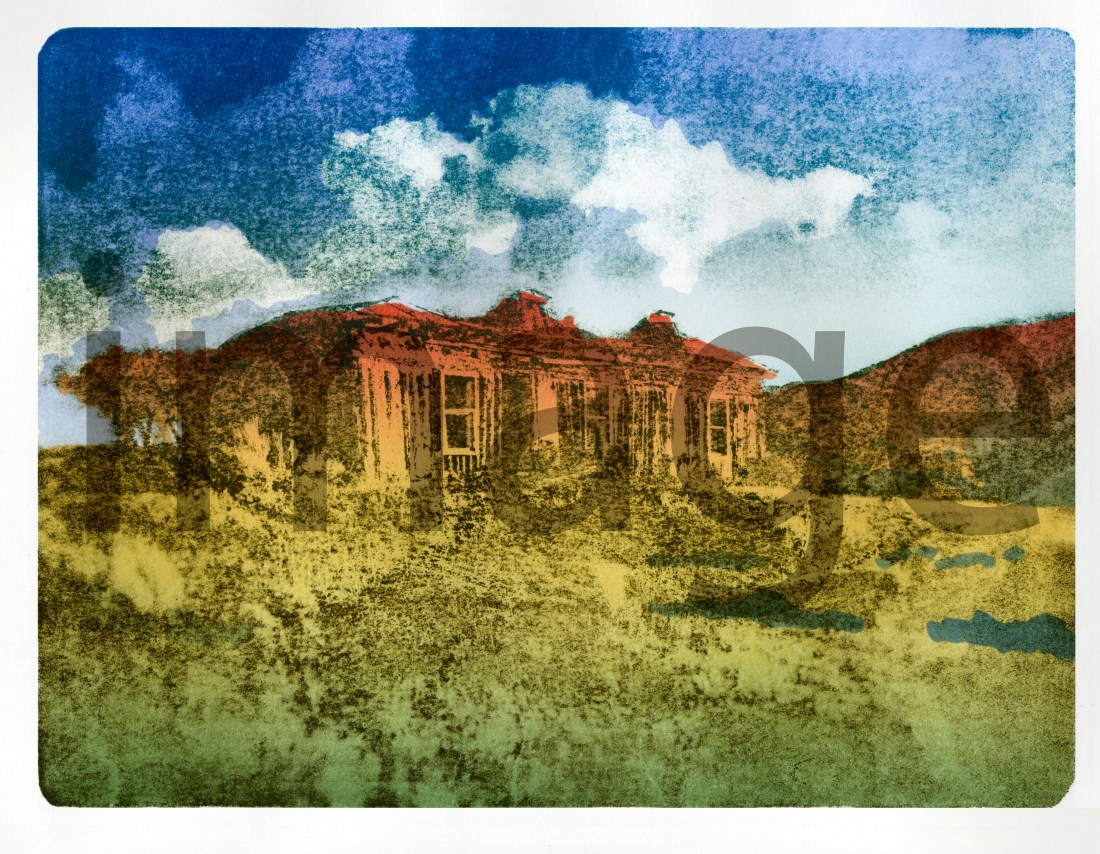
Mi Casa es su Casa. solarplate etching, 2016.
Casa de Tierra [Home of Earth]
Casa de mi Tierra [Home of my Land]
Mi Casa es su Casa
Jacal de Memoria [Hut of Memory]
Jacal del un Sueno [Hut of a Dream]
Mi Casa es su Casa
Ramas y Tierra [Braches and Earth]
Temporal pero Fijo [Temporary but firm]
Mi Casa es su Casa
Raíces y Polvo [Roots and Dust]
Volverá a la Tierra [It will return to the earth]
Mi Casa es su Casa
- The jacal is an adobe-style housing structure historically found throughout parts of the southwestern United States and Mexico. This type of structure was employed by some Native people of the Americas prior to European colonization and was later employed by both Hispanic and Anglo settlers in Texas and elsewhere.
- The jacal in my lithograph is located in Northern New Mexico in the small town of Amilia.
- A Jacal was sometimes built as a temporary shelter before an adobe home would be built. The adobe bricks where labor intensive so a temporary shelter was required for protection from the weather.
- I was born in Santa Fe, New Mexico and my family from my mother’s side is from Pecos, New Mexico and my father’s side is from Colonias, New Mexico.
- I spent many of my childhood summers in Pecos with my material grandmother.
- I got to meet, live, play and work with extend family members during those summer.
- Even in the 1960’s while living in Pecos as a child, life there was isolated, traditional, cultural and agrarian. – Tony Ortega –
Sue Pearson: is a descendant of the mutineers of the HMS Bounty and the Tahitian women who settled on Pitcairn Island in the 18th Century, and later Norfolk Island. Sue grew up on Norfolk Island and though she now lives most of the year in New Zealand with her husband and children, she maintains strong ties with her home, family and land. Sue works independently in her home print studio and regularly travels back to Norfolk Island. Sue runs Pili Printmaking Workshops, The Norfolk Island Print Studio and is the creator/designer for Aatuti Art, Norfolk Island. She is also co-founder/designer of Pili Pacific, a contemporary Pacific designer label based in Hawaii.
Pearson’s interpretations of her personal heritage, narratives and ideas are at sometimes easily accessible and at other times personally coded or in a visual language understood by Norfolk Islanders. Pearson creates works that share the stories of her life, thoughts, home and heritage and provide vehicles for connections on a range of levels of experience. suepearson.pilidesign@gmail.com

Hoem. Drypoint / collagraph on Somerset paper, 2016.
Hoem (home) for me is so very clearly Norfolk Island. I have lived away from home in New Zealand for 13 years and raised my children mostly here but Norfolk will always be home for me. But how to make a single print about how I understand home? Home is a constellation of memories, of loved ones, of my heritage, of practices, of happenings in special places, of smells, sounds and tastes, of salt and earth and ocean, of light, of the past and plantings for the future. Its where I breath most easily, where I hope to return to live there at some time and its where my bones will one day lie. – Sue Pearson –
Glory Tacheenie-Campoy: is Dine/Navajo and a member of the Tall Tower Clan (Kinyaanii) and Deer Water Clan (Bih bitooni), from Northern Arizona. She was born on the Dine reservation, attended U.S. government Indian boarding school K-12th in Arizona. Glory’s family raised sheep and used the sheep wool to weave rugs. When Glory was 7 years old, her mother taught her the art of weaving rugs. At school and the University she was introduced to painting, drawing, sculpting, printing, dance and music etc. Glory’s work is inspired by her Dine/Navajo worldview and formal art training. The artist enjoys the process of experimenting with various media and techniques to creates prints, paintings, mix media art, is member of the Arizona Print Group and Raices Taller 222 artists in Tucson, AZ. For more Information: http://www.arizonaprintgroup.com and http://www.raicestaller222.com
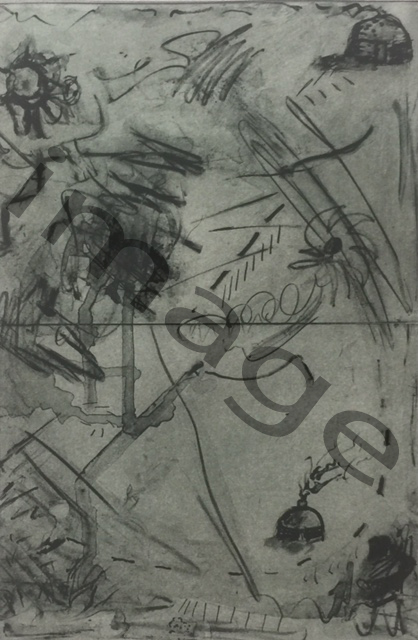
Hooghan. Etching, 2016
Hooghan (hogans) in a landscape took me back to my childhood home. Dirt floor, no electricity or running water. We spent our days making sure we had fire wood, water and food. We raised sheep and sometimes supplemented our diet with wild game and grew corn, melons, etc. There was time for family gatherings and ceremonies. Life was hard but we worked collaboratively to survive . We had wonderful times and challenging times. Today I live in a house with electricity, running water in Tucson. I am retired and now work as a full time artist. I love my time creating art and enjoy time with friends and family. I am grateful for opportunities like this print exchange with Melanie and participating artists. – Glory Tacheenie-Campoy –
Melanie Yazzie: is of the Salt Water Clan and Bitter Water Clan of the Diné People of North Eastern Arizona. She is Professor of Art and Head of Printmaking at the University of Colorado in Boulder, Colorado. Her works belong to many collections, including the Anchorage Museum of History & Art, the Art Museum of Missoula, the Kennedy Museum of Art. Yazzie has exhibited nationally and internationally in places such as Alaska, California, New Mexico, New York, Florida, New Zealand, France, Russia, Canada and Japan. She often takes part in collaborative art projects with indigenous artists in New Zealand, Siberia and Australia. Of her journeys she says: “It’s at these gatherings and traveling from place to place that fuels my work and revitalizes my spirit!

Wishing for Water. 6 color Screenprint, 2016
I was thinking a lot about home and all the random places I have gone over the years that make home, home. Home for me is everywhere on the Navajo Nation. It is the food I eat on the side of the road at a remote Navajo taco stand, a flea market in Gallup or Chinle, the dirt road that takes you to Canyon De Chelly, the odd places you come across that can only be found at home. All of it. The people, plants, animals and the ceremony of it all is home for me. Originally I made myself with buffalo horns, me being a CU Buff/yes silly, but very Yazzie, which later I saw the horns as our sacred mountains on my mind with clouds around them as I always am thinking and praying for rain for home. That was always the request from my grandparents when I grew up. They would say, “We pray for rain, we need that. The water is sacred to us all.” So in my print I am being filled with the rain and being whole again. – Melanie Yazzie –
Kevin Slivka: is Associate Professor of Art Education with the State University of New York [SUNY] at New Paltz and previously taught at the University of Northern Colorado [UNC]. He continues to learn from and work with Ojibwe artists from northern Minnesota and Indigenous artists from Colorado who have heavily informed his professional interests concerning cultural studies, Indigenous knowledge(s), and ecological relationships embedded within art processes. He has presented papers at international, national, and state conferences, and has been published in The Journal of Social Theory in Art Education, Studies in Art Education, Marilyn Zurmuehlen Working Papers in Art Education, and the Art Education journal. He also co-directed “Interchange: Arts in Contemporary and Traditional Culture,” that prominently featured Indigenous artists, scholars, and educators at the Center for Integrated Arts Education at UNC, which was supported with a National Endowment for the Arts grant.

Rhiz[home]. monochrome hand-pulled block print, 2016
This print is inspired by low-bush blueberry plants; rhizomes that mark significant ongoing relationships with/in the woodlands of northern Minnesota with Dewey Goodwin, Bambi Goodwin, Melvin Losh, and Pat Kruse. This interrelatedness is suggested by the inclusion of fern; a rhizome that has always grown at my childhood home in a Pittsburgh, Pennsylvania suburb as well as within my new home ecology, the Hudson Valley in upstate New York. Not formally trained as a printmaker, I am humbled by this arts process and grateful to be invited to participate as a contributing artist and writer. – Kevin Slivka –
* notes participating artists who have agreed to have their print, artist statement, and biography to be hosted on this site.
 Indigenous Arts, Culture, and Education